GoHighLevel sells one promise: replace your CRM, funnel builder, email tool, SMS platform, booking calendar and review manager with a single subscription. This GoHighLevel review tests that promise against the only number a small business actually cares about, which is what lands on the invoice at the end of the month.
The short answer is that the sticker price is honest and the usage fees are not hidden, but they are very easy to miss. Whether GoHighLevel is worth it comes down to one question. Are you consolidating tools you already pay for, or are you buying capability you do not currently use? The first case usually saves money. The second case usually costs more than people expect.
What this review covers
- The short version
- What GoHighLevel actually is
- GoHighLevel pricing in 2026
- A realistic monthly cost example
- What GoHighLevel replaces in a typical stack
- Where GoHighLevel is genuinely good
- Where GoHighLevel falls short
- Who should skip GoHighLevel
- GoHighLevel vs n8n, Zapier and Make
- Which plan should you actually buy
- What this GoHighLevel review means for agencies
- Verdict
- Frequently asked questions
- Getting it set up properly
The short version
What you need to know before you sign up
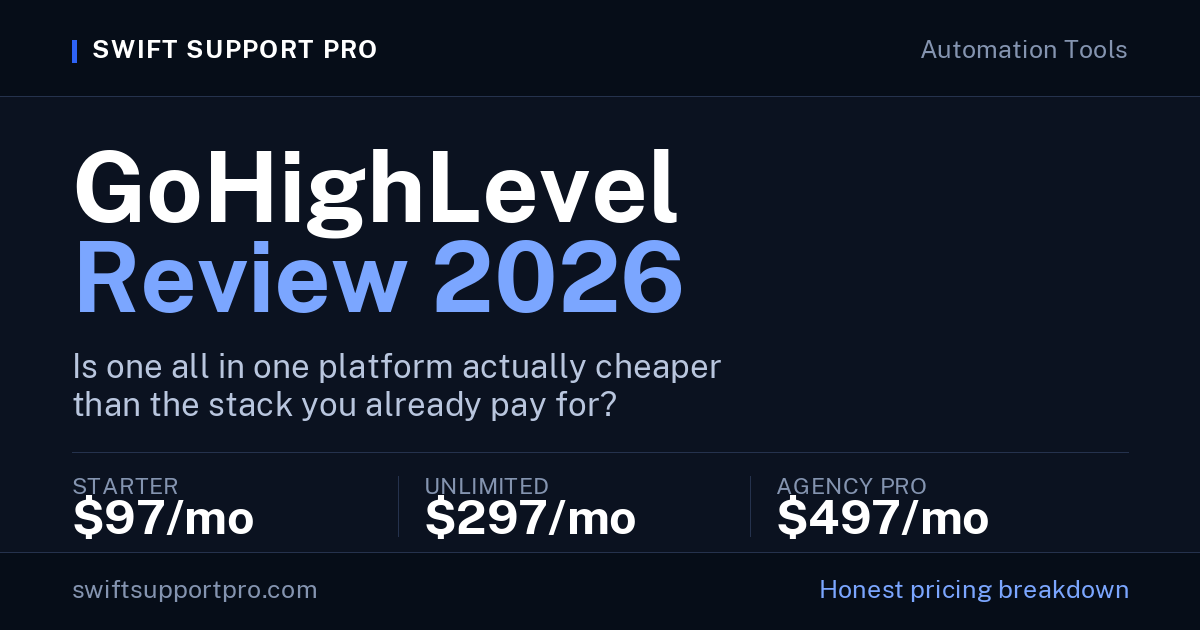
- Three plans in 2026: Starter at $97/mo, Unlimited at $297/mo, Agency Pro at $497/mo
- Annual billing cuts roughly 17 percent off every tier
- Unlimited contacts and unlimited users on all three plans, including Starter
- Starter now includes 3 sub-accounts, not 1
- SMS, calls, email and AI usage are billed separately on top of the plan
- Best value when you are replacing four or more paid tools at once
What GoHighLevel actually is
GoHighLevel is an all in one sales and marketing platform originally built for agencies. The core of it is a CRM with pipelines, and everything else hangs off that: funnels and landing pages, a website builder, email and SMS campaigns, booking calendars, a unified conversations inbox, review requests, forms and surveys, a course builder, and an automation workflow engine.
The piece that confuses most small business owners is the sub-account structure. A sub-account is one isolated business: its own contacts, pipelines, funnels, calendars and settings. If you run a single business, you use one sub-account and ignore the rest. If you serve clients, each client gets their own. This is why the pricing tiers are built around sub-account limits rather than contacts or seats.
That agency heritage cuts both ways. You get an enormous amount of functionality for the money, and you also get an interface designed for people who set up systems for a living. It is not a tool you open on a Tuesday afternoon and have running by Wednesday.
GoHighLevel pricing in 2026
There are three public tiers. Every one of them includes unlimited contacts and unlimited users, so you are not punished for growing your list or adding staff.
| Plan | Monthly | Annual (approx) | Sub-accounts | Built for |
|---|---|---|---|---|
| Starter | $97 | $970/yr | 3 | Solo operators, single-location businesses |
| Unlimited | $297 | $2,970/yr | Unlimited | Agencies doing the work for clients |
| Agency Pro | $497 | $4,970/yr | Unlimited | Reselling the platform as your own software |
What the three plans actually change
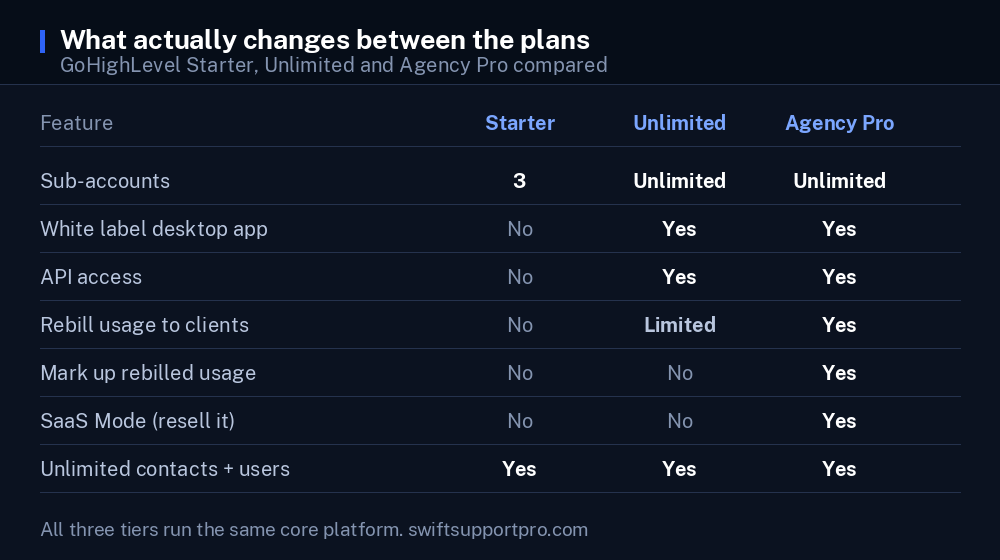
This is where most comparison articles get sloppy. Starter is not a stripped down version of the platform. It runs the same core product as the $497 tier. The plans differ on four things and four things only: how many sub-accounts you get, how deep the white labelling goes, whether you can rebill usage to clients at a markup, and whether you get API access.
One correction worth making, because outdated posts still repeat it. Starter includes three sub-accounts in 2026, not one. For a single business that is more headroom than you will use. For an agency it means you can carry two clients before the upgrade becomes unavoidable.
Agency Pro is the only tier that turns GoHighLevel into a product you sell. It unlocks SaaS Mode, which lets you repackage the whole platform under your own brand at your own price, and it is the only tier where you can mark up usage costs when you rebill clients. If you are not building a software business, it is money you do not need to spend.
The usage fees that are not in the sticker price
This is the part that produces bill shock, and it is the single most useful thing in this review. Your subscription buys the software. It does not buy the messages.
Phone numbers, SMS, MMS and call minutes run through LC Phone, GoHighLevel’s own telephony layer built on Twilio. Email runs through a similar arrangement. These are metered and deducted from a prepaid wallet that auto-recharges when it drops below a threshold you set. GoHighLevel’s published position is that LC Phone base rates track Twilio pricing and come in slightly cheaper in common categories such as US and Canada SMS, and that US carrier fees are passed through without markup.
Two things follow from that. First, the per-message rate you see quoted in most articles is only the base rate. US carriers add per-segment fees on top, and those are set by the carriers, not by GoHighLevel. Second, your real monthly cost depends entirely on volume. A consultant sending appointment reminders will barely notice it. A business running SMS campaigns to a large list will notice a great deal.
The AI features are the other line item people miss. Conversation AI, Voice AI, Reviews AI and Content AI are available pay as you go, or bundled into an AI Employee subscription priced separately from your plan and charged per sub-account. If the AI voice agent is the reason you are looking at GoHighLevel in the first place, budget for it as a separate product rather than assuming it is included.
A realistic all in figure for a small business running normal volume is the plan price plus somewhere in the range of $20 to $150 a month, and materially more if you lean on AI voice or heavy SMS. Check current rates inside your own billing settings before you scale anything, because carrier fees move.
A realistic monthly cost example
Numbers in isolation are hard to judge, so here is roughly how the maths lands for a small service business. Treat this as a shape rather than a quote, because rates move and your message volume is your own.
Take a two person business with a contact list in the low thousands. They send appointment reminders by SMS, one email a week, and a short follow up sequence for new leads. On Starter that is $97 for the plan. Add a phone number, a month of SMS segments including the fees the carriers charge on top, and the email sends, and the usage side generally lands in the low tens of dollars. Call the realistic all in figure somewhere around $120 to $140.
Now change one variable. Switch on an AI voice agent to answer inbound calls. The AI Employee subscription is priced separately from your plan and charged per sub-account, and voice minutes are metered on top of that again. The same business can move from roughly $130 a month to comfortably past $250 without adding a single contact to the database.
None of that is hidden, and none of it is unreasonable for what you get. It is simply the part people fail to model before they migrate. The lesson from any GoHighLevel review worth reading is the same: work out your message volume first, then choose the tier. The plan price is the predictable number. Usage is the one that moves.
What GoHighLevel replaces in a typical stack
The consolidation argument is the whole case for the platform, so it is worth doing the arithmetic honestly. Here is a fairly ordinary small business stack and what GoHighLevel absorbs.
| Job to be done | Typical separate tool | Covered by GoHighLevel? |
|---|---|---|
| CRM and pipelines | HubSpot, Pipedrive | Yes |
| Funnels and landing pages | ClickFunnels, Leadpages | Yes |
| Email marketing | Mailchimp, ActiveCampaign | Yes, plus usage fees |
| SMS follow up | Twilio, SimpleTexting | Yes, plus usage fees |
| Booking calendar | Calendly, Acuity | Yes |
| Review requests | Birdeye, Podium | Yes |
| Courses and memberships | Teachable, Kajabi | Yes |
| Deep app to app automation | n8n, Zapier, Make | Partly, see below |
Add up what you currently pay across those rows. If the total comfortably clears $297 and you would genuinely use most of the replacements, the consolidation case is strong. If you are paying for two of them and hoping to grow into the rest, you are buying a bigger platform than your business currently needs, and the extra capability tends to sit unused.
Where GoHighLevel is genuinely good
Speed to lead. Because the CRM, the calendar, the SMS layer and the automation engine live in one database, a new form submission can trigger a text, book an appointment and move a pipeline card without a single integration in between. This is the thing GoHighLevel does better than a stitched together stack, and it is not close. Every handoff you remove is a handoff that cannot silently fail at 2am.
The unified inbox. SMS, email, Facebook and Instagram messages, Google Business messages and web chat all land in one conversation thread per contact. For a business where the owner is also the person replying to leads, this alone removes a real daily cost.
Predictable pricing on the things that usually punish growth. Unlimited contacts and unlimited users on every tier is unusual. Most CRMs charge per seat, and most email tools charge per contact. If your list is growing, that difference compounds.
Snapshots. You can package an entire configured sub-account, including workflows, funnels, calendars and pipelines, and deploy it to a new one. If you run the same playbook for similar businesses, this turns a two week setup into an afternoon.
Where GoHighLevel falls short
The honest weaknesses are consistent and worth taking seriously before you commit.
Setup is not a weekend. Expect a few weeks to get a real system live, longer if you are migrating existing data and sequences. The platform assumes you know what a pipeline stage, a trigger and a custom value are. That learning curve is the most common reason subscriptions get cancelled in month two.
Individual modules are good, not best in class. The email builder is not ActiveCampaign. The funnel builder is not Webflow. The course platform is not Kajabi. You are trading peak quality in each category for the fact that they all share one contact record. That is usually a good trade, but it is a trade.
SMS compliance is a real project. A2P registration, opt in handling and carrier policy are your responsibility, and getting it wrong means messages quietly stop being delivered. Budget time for it rather than discovering it mid campaign.
Pros
- One database behind CRM, funnels, SMS, email and calendars
- Unlimited contacts and users on every plan, including Starter
- Replaces four to seven separate subscriptions for many businesses
- Snapshots make repeat setups genuinely fast
- Strong AI voice and chat features available
- Rebilling turns usage into agency margin on Agency Pro
Cons
- Steep learning curve, realistic setup measured in weeks not days
- Usage fees for SMS, email, calls and AI sit on top of the plan
- Individual modules are solid rather than best in class
- Support quality is inconsistent by most user accounts
- Overkill if you only need two of the tools it replaces
- A2P and SMS compliance is your problem to solve
Who should skip GoHighLevel
A GoHighLevel review that only lists strengths is a sales page with extra steps. There are four situations where the honest answer is to buy something else.
- You need one job done exceptionally well. If email marketing is genuinely the heart of your business, a dedicated platform will beat GoHighLevel on deliverability tooling and segmentation depth.
- Nobody owns the setup. This platform punishes part time attention. If no one on your team has a few weeks to configure it properly, it will sit half built and bill you monthly regardless.
- Your operation runs on bespoke systems. If the real work happens in custom internal software, a warehouse system or a niche industry database, you need a proper automation layer more than you need another CRM.
- You are pre revenue and still testing the offer. Buy the platform once you know which process you are systemising. Buying it in order to discover that process is the most expensive way to learn it.
GoHighLevel vs n8n, Zapier and Make
This comes up constantly and the comparison is slightly wrong at the premise. GoHighLevel is a system of record with automation attached. n8n, Zapier and Make are automation layers with no system of record of their own. They are not really competitors, and plenty of setups run both.
GoHighLevel’s internal workflow builder is excellent at anything that happens to a contact inside GoHighLevel: send the text, wait two days, check whether they booked, move the pipeline stage, notify the owner. It is weak the moment you need to reach outside, transform data properly, call an arbitrary API, or handle branching logic with any real complexity.
The practical pattern is to let GoHighLevel own the customer conversation and the pipeline, and let a dedicated automation platform handle the connections to accounting, inventory, internal databases and anything bespoke. If you are choosing between those platforms, we broke the costs down in n8n vs Zapier vs Make, where the headline finding is that all three publish a monthly cap and all three count completely different things.
Which plan should you actually buy
Buy Starter if you run one business, or two, and you want the full platform. You get the same core product as everyone else and three sub-accounts. Most solo operators, consultants, coaches and single location businesses never need more than this, and a good number of people who were upsold to Unlimited would have been fine here.
Buy Unlimited when the third client makes the sub-account cap bite, or when you need API access and white labelling so clients see your brand rather than GoHighLevel’s. This is the standard agency plan and the point where the platform starts paying for itself against retainers.
Buy Agency Pro only when you have decided to sell the software itself. It breaks even at roughly two clients paying $297, so the maths works quickly, but only if SaaS Mode is an actual business decision rather than an aspiration. If you are not there yet, start on Unlimited and upgrade when you are.
Whichever tier you pick, take the free trial and put one real workflow live during it. Not a test contact. A real lead source, a real follow up sequence, a real calendar. The trial tells you nothing if you spend it clicking around the settings.
What this GoHighLevel review means for agencies
If you build systems for clients, there is a second economic layer worth understanding. GoHighLevel runs one of the more generous recurring affiliate programs in the category, paying 40 percent monthly for as long as the referred account stays subscribed. On the $297 tier that is roughly $119 a month per client, running alongside whatever you charge to build and manage the system.
The reason this matters is retention rather than commission rate. A CRM that holds a business’s pipeline, calendar and conversation history is not a subscription people cancel casually. That makes the revenue unusually stable compared with most affiliate income.
Separately, on Agency Pro, rebilling lets you mark up SMS, email, voice minutes and AI usage when you pass those costs to clients. Most agencies absorb that spend without thinking about it. Configured properly it is margin.
Verdict
GoHighLevel is worth it if you are consolidating a real stack and you are willing to invest a few weeks in setup. It is not worth it if you are buying it in the hope that owning the tools will produce the system. The platform rewards people who already know what process they want to automate.
For a single small business, Starter at $97 is one of the better value propositions in the category, provided you actually use four or more of the things it replaces. For an agency, Unlimited at $297 is close to a default choice. Just go in with your eyes open about usage fees, and check the current rates yourself rather than trusting any article, including this one.
GoHighLevel
Price: From $97/mo, plus usage
Best for: Businesses replacing four or more tools, and agencies serving multiple clients
Start a free trialFrequently asked questions
How much does GoHighLevel cost per month?
GoHighLevel costs $97 a month on Starter, $297 on Unlimited and $497 on Agency Pro. Annual billing reduces each by roughly 17 percent. Those are base plan prices. SMS, calls, email and AI usage are metered and billed separately on top.
Does GoHighLevel have a free trial?
Yes. GoHighLevel offers a free trial with full access to the plan you choose, and a credit card is required to start it. Trial length has varied between 14 and 30 days depending on the signup route, so check the length shown at checkout before you commit.
How many sub-accounts does the Starter plan include?
Three. Older articles still claim Starter includes only one sub-account, which is out of date. Three is enough for a single business with room to spare, or for an agency carrying two clients before it needs to upgrade.
Does GoHighLevel replace Zapier, Make or n8n?
Only partly. GoHighLevel automates anything that happens to a contact inside GoHighLevel very well. It is weaker at connecting to outside systems, transforming data or calling arbitrary APIs. Many setups run GoHighLevel as the system of record with a dedicated automation platform handling external integrations.
Is GoHighLevel worth it for a small business, not an agency?
Yes, if you would genuinely use four or more of the tools it replaces, such as CRM, funnels, email, SMS, booking and review requests. If you only need two of them, a smaller focused stack will be cheaper and much faster to set up.
Getting it set up properly
Most of the value in a platform like this shows up in the first workflow you get right, not in the feature list. If you want a broader view of what to automate first, our guide to AI automation for small business covers the workflows that return money soonest, and agentic AI automation covers where this is heading next.
If you would rather have the system built and handed over working, that is what we do at Swift Support Pro.
See current GoHighLevel pricing